Internship vs Fellowship: What Is the Difference?
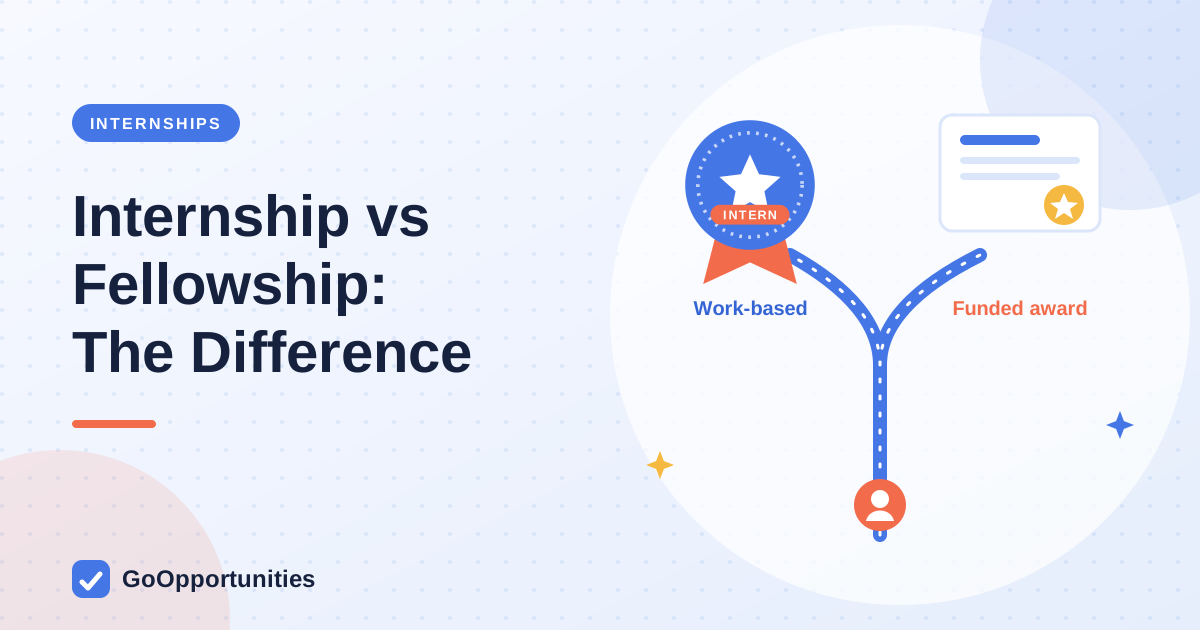
An internship is a short period of work-based learning inside an organization, usually for students or recent graduates. A fellowship is usually a funded award that supports a person to study, research or develop professionally, often with a cohort or a mentor. The two overlap, and the labels are used loosely, so always read what the program actually offers.
This guide compares them on purpose, pay, length, selection and fit, then shows how to decide. You can browse current internships and fellowships on GoOpportunities and check each program on its official page.
Short definitions
- Internship: you join an employer or institution and do supervised work, usually for weeks or months. The goal is experience and a possible route to a job.
- Fellowship: you receive a competitive award or placement to pursue a defined goal, such as research, a policy project, language study or leadership training. Funding, mentoring and a network are common features.
Some organizations use “fellow” as a job title for a paid, time-limited role. The word alone does not tell you whether it is an award or a position.
Internship vs fellowship at a glance
General patterns only. Individual programs differ, so verify on the official page.
| Feature | Internship | Fellowship |
|---|---|---|
| Main purpose | Learn by doing work for an organization | Pursue a funded project, study or development goal |
| Typical applicant | Students and early-career applicants | Varies: students, graduates or experienced professionals |
| Pay | Paid, stipend-based or unpaid | Often a stipend or grant, sometimes with travel or insurance |
| Length | Usually weeks to a few months | Often several months to a year or more |
| Selection | CV, cover letter, interviews | Often a proposal, essay, references and panel review |
| Output | Work experience and references | A project, research output, credential or network |
What an internship looks like
You are usually assigned to a team and a supervisor, given tasks that support live work, and expected to follow the organization’s hours and rules. Learning happens through the work itself.
Pay varies widely. Some internships pay a wage, some pay a stipend, and some are unpaid. Read the listing and the offer letter. If pay is not shown on our listing, the source did not state it, so ask the employer. For a deeper look at pay and visas, read our guide to paid internships abroad.
What a fellowship looks like
A fellowship is usually built around you and your plan rather than around a team’s task list. You may propose a research topic or project, receive funding to carry it out, and join a group of other fellows. Some programs place you at a host organization, which is where the line with internships blurs.
Programs such as the Fulbright Foreign Student Program are structured as grants for study and research, which is a useful example of the award model. Selection is often competitive and the application can resemble a scholarship application, with a statement, references and a CV.
How to choose between them
- If you need first work experience and a reference, start with internships.
- If you have a research or project idea and want funding to pursue it, look at fellowships.
- If you are still a student, check whether your degree credits an internship or a fellowship period.
- Compare pay, length, location and visa support in writing for each option.
- Consider doing both in sequence: an internship can build the experience that a fellowship application needs.
How the applications differ
For internships, lead with a targeted CV and a short cover letter that maps your experience to the posting. Our CV guide for jobs abroad covers the format.
For fellowships, expect a longer application. You may need an essay or proposal, so read how to write a statement of purpose, and line up referees early using our guide to recommendation letters.
Red flags for both
- You are asked to pay a fee to be considered or to “secure” a place.
- The program cannot name who funds it or who runs it.
- There is no written description of duties, pay or duration.
- The visa or work permission arrangement is vague.
- The contact uses a personal email address and avoids video calls.
Visa rules for interns and fellows differ by country and by program. Use the destination government’s immigration website as the final authority.
How the labels are used in practice
Organizations are not consistent. A think tank may call a paid, year-long research role a fellowship, a university may call a funded research placement an internship, and a company may call a rotational graduate program a fellowship. The label tells you less than the details: who selects you, what you do day to day, how long it lasts, what you are paid and what you leave with.
Eligibility patterns to expect
- Internships often ask for current enrolment or recent graduation, a relevant field and availability for the full period.
- Fellowships often ask for a degree, a project or research plan, references and sometimes nationality or residence rules.
- Both may set language requirements and require permission to work or stay in the country.
Preparing a fellowship application step by step
- Read the call and the selection criteria twice.
- Write a one-paragraph summary of what you will do and why it matters.
- List what you will deliver and when, in realistic stages.
- Explain why you and why this host or funder.
- Ask referees early and send them the call.
- Have a mentor read the full draft and challenge your assumptions.
Timing, visas and money
Fellowship deadlines can be many months before the start date, while internship deadlines depend on the employer’s hiring cycle. In both cases, check how the program handles visas and what the stipend or wage must cover. Compare it with realistic living costs in the destination city before you accept.
Three example situations
A final-year student with no work experience and a limited budget might aim for a paid internship to build a reference. A graduate with a clear research question might look for a fellowship that funds a year of work on it. Someone changing career might choose a short internship to test a field before committing to a longer, competitive program.
These are illustrations of the reasoning, not rules. Use them as a prompt to write down your own goal, your constraints and the evidence each option would give you.
Next steps
Browse current internships and fellowships, shortlist the programs that match your goal, and open the official page for each before you prepare documents. If your target is further study, read our guide to finding fully funded master’s scholarships.
Frequently asked questions
Is a fellowship better than an internship?
Neither is better in general. An internship builds work experience, while a fellowship funds a project, study or development goal. Choose the one that matches your next step.
Are fellowships always paid?
Many include a stipend or grant, but terms vary. Read the benefits section of the official program page.
Can I do an internship and a fellowship?
Yes, and many people do, often one after the other. Check that the terms of each program allow it.
Do I need a degree for a fellowship?
It depends on the program. Some are for students, others for graduates or professionals. Check the eligibility section.
Which looks better on a CV?
Both can. What matters is what you did and learned. List the role, the organization, the dates and what you produced.
Official sources
Confirm current rules on the provider site. Links open in a new tab.
This article is general guidance from the GoOpportunities editorial team. Eligibility, deadlines, funding and visa rules change. Always confirm details on the official provider or government website before you apply. We do not host applications.